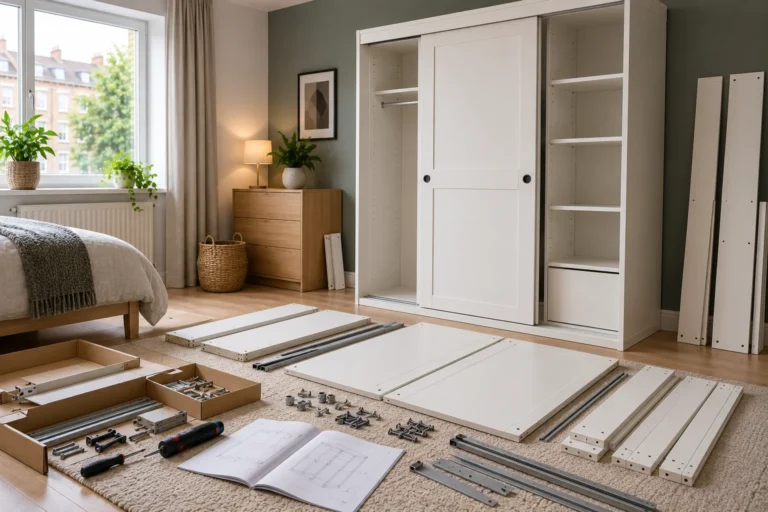
Divan vs Frame: Which Bed Type Is Quicker to Build (and Move)
Choosing a new bed is about much more than comfort. It also affects how long installation takes, how easy it is to move house, and how much effort you’ll need if you ever rearrange your bedroom. Many homeowners only think about these factors after the flat-pack boxes arrive or moving day begins. Understanding divan bed assembly before you buy can save hours of work and help you avoid unnecessary frustration.
While both divan and frame beds are designed to support a mattress securely, they are built very differently. Those differences affect assembly time, transport, storage, maintenance, and even long-term durability. Whether you’re furnishing a new home, upgrading your bedroom, or preparing for a move, knowing which option fits your lifestyle can make the entire process much easier.
According to the UK Office for National Statistics (ONS), hundreds of thousands of people move home across England and Wales every year, making furniture that is easy to dismantle and transport an important consideration for many households. At the same time, research from IKEA shows that flat-pack furniture remains one of the most popular choices because it is easier to transport and store before assembly.
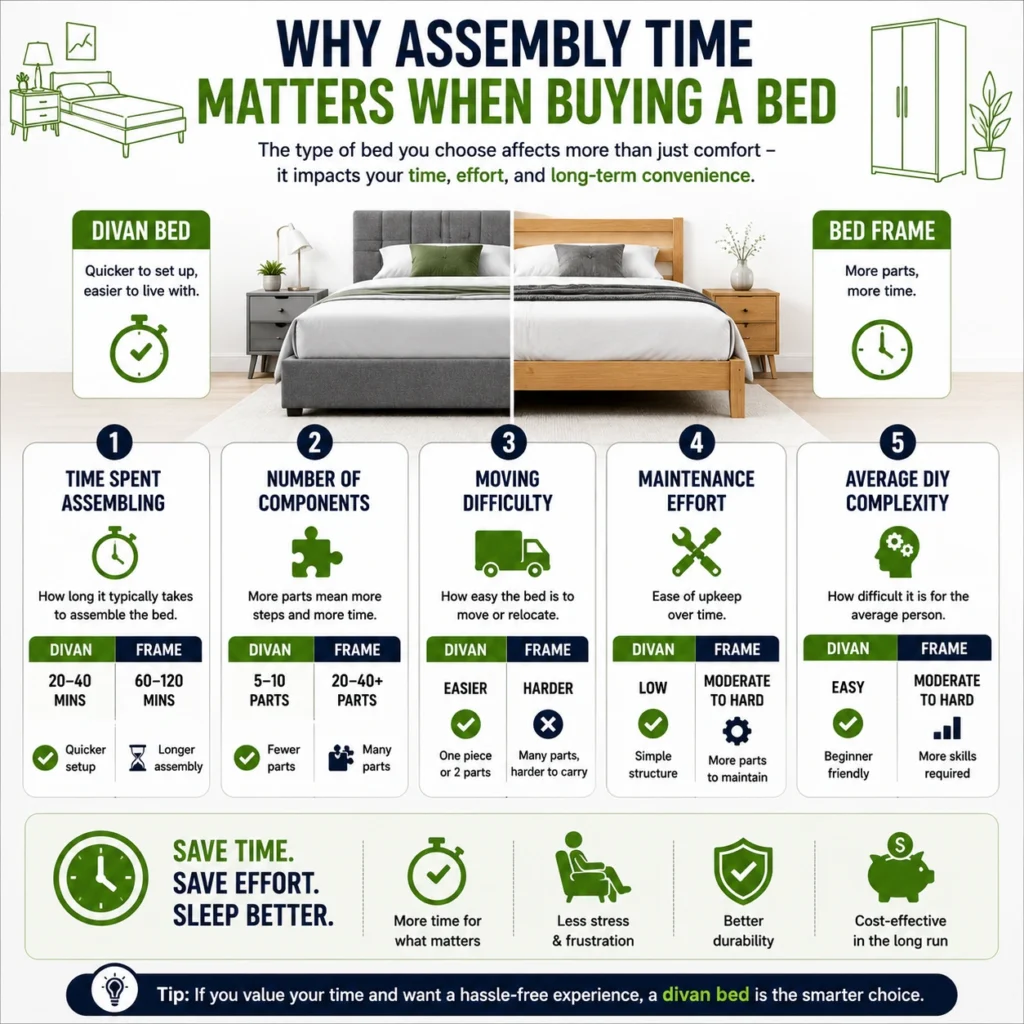
Why Bed Assembly Time Matters More Than Most People Think
Many people assume that every bed takes roughly the same amount of time to assemble. In reality, the design of the bed has a huge impact on how quickly it can be built.
Assembly time affects more than convenience. It also influences:
- Delivery and installation costs
- Moving house expenses
- Risk of incorrect assembly
- Long-term maintenance
- Ease of future disassembly
A simpler structure often means fewer tools, fewer fittings, and fewer opportunities for mistakes.
Understanding Divan Beds
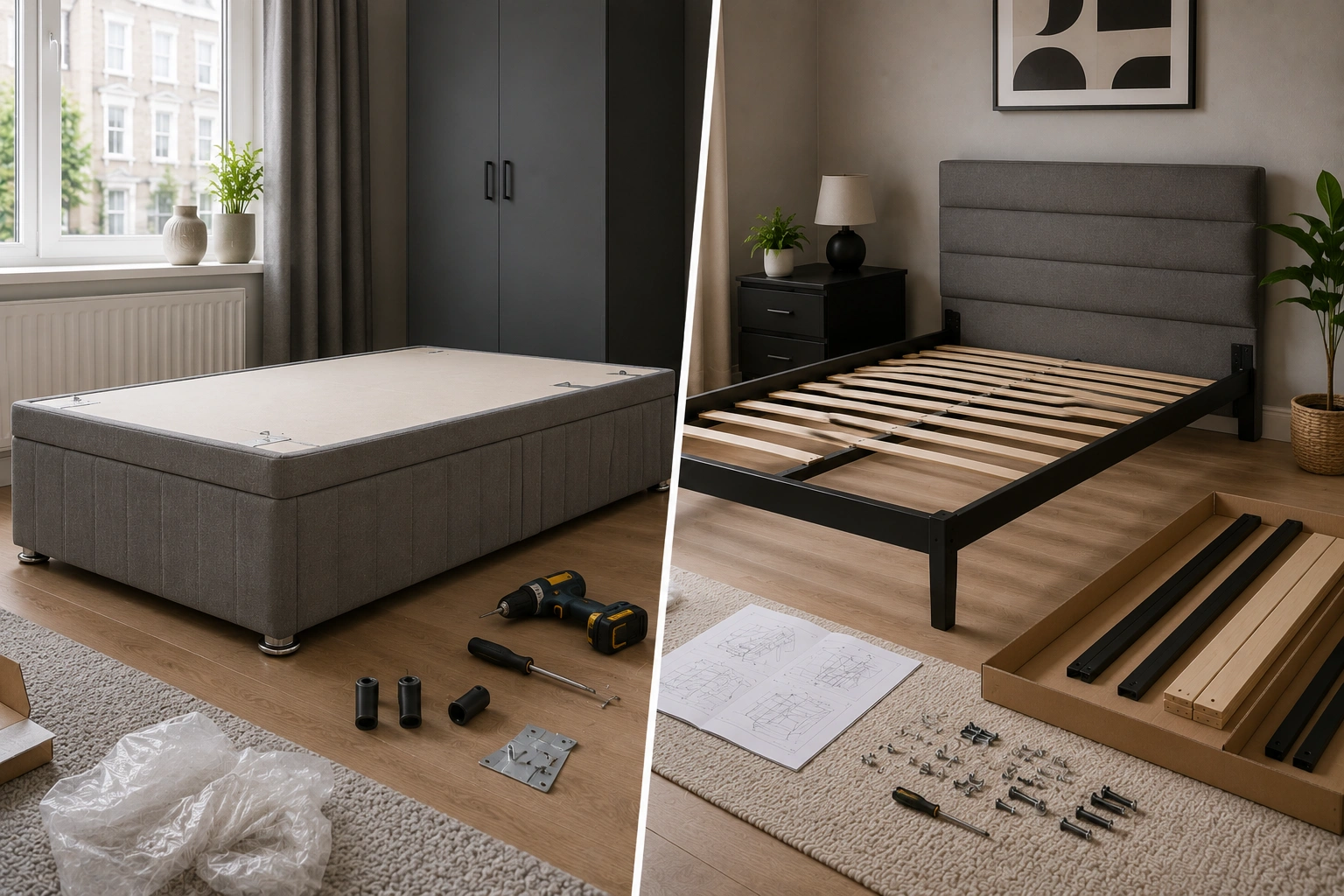
A divan bed is usually made from one or two upholstered bases with built-in support. Many models include storage drawers or ottoman lifting mechanisms.
Unlike traditional frame beds, the structural support already exists inside the base. Assembly mainly involves connecting the sections, attaching the headboard if required, and fitting the feet.
Because fewer structural components need to be installed, divan bed assembly is generally quicker than assembling many wooden or metal frame beds.
Typical Components
Most divan beds include:
- Upholstered base sections
- Joining brackets
- Bed feet or castors
- Optional headboard
- Optional storage drawers
The limited number of components reduces both assembly time and the chance of installation errors.
Understanding Frame Beds
Frame beds are available in wood, metal, upholstered, and hybrid designs. Unlike divan beds, the frame itself provides the structural support.
This means the installer usually needs to assemble multiple individual parts before the bed becomes stable.
These commonly include:
- Side rails
- Headboard
- Footboard
- Central support beam
- Slats
- Brackets
- Bolts and screws
The larger number of components naturally increases installation time.
Why Frame Beds Often Take Longer
Each connection point must be aligned correctly.
Even small alignment errors can make fitting the slats difficult or create squeaks later.
Storage frame beds usually add lifting mechanisms, hydraulic pistons, or extra panels, making installation even more time-consuming.
Divan Bed Assembly vs Frame Bed Assembly
The biggest difference between the two comes down to complexity.
A divan arrives largely pre-built, while a frame bed usually arrives completely flat-packed.
Below is a comparison of both options.
| Situation | Recommended Bed Type | Reason |
|---|---|---|
| Frequent house moves | Divan Bed | Quick to dismantle and transport. |
| Fastest installation | Divan Bed | Fewer components make assembly quicker. |
| Traditional appearance | Frame Bed | Offers a wider variety of styles and designs. |
| Simple maintenance | Divan Bed | Fewer exposed fittings and bolts to maintain. |
| Custom bedroom aesthetics | Frame Bed | Greater choice of materials, finishes, and designs. |
Although assembly times vary by manufacturer, professional installers consistently report that divan beds are among the quickest bed styles to install because most structural work has already been completed at the factory.
Which Bed Is Easier to Move?
Moving day quickly reveals whether a bed was designed with portability in mind.
Divan beds usually separate into two compact sections. This makes carrying them through narrow staircases, hallways, and apartment buildings much simpler.
Frame beds require full disassembly before transport.
Every slat, support rail, bolt, and bracket must be removed, packed safely, and reassembled at the new property.
If parts are misplaced during the move, rebuilding the bed becomes much more difficult.
Moving Difficulty & Assembly Calculator
Calculate how difficult your bed will be to relocate, along with structural breakdown and rebuild timeframes.
*Time calculations assume baseline knowledge of structural fasteners. Ottoman gas cylinders require specialized decompression handling during flat transit to avoid frame warping.
Does Bed Size Affect Assembly Time?
Absolutely.
Regardless of design, larger beds require more lifting, alignment, and adjustment.
For example:
| Bed Size | Typical Divan Assembly | Typical Frame Assembly |
|---|---|---|
| Single | 15–25 minutes | 35–60 minutes |
| Double | 20–35 minutes | 45–75 minutes |
| King Size | 30–40 minutes | 60–90 minutes |
| Super King | 35–45 minutes | 75–120 minutes |
Larger frame beds also include longer side rails and additional centre supports, increasing installation time.
Common Mistakes That Slow Down Bed Assembly
Many installation delays are avoidable.
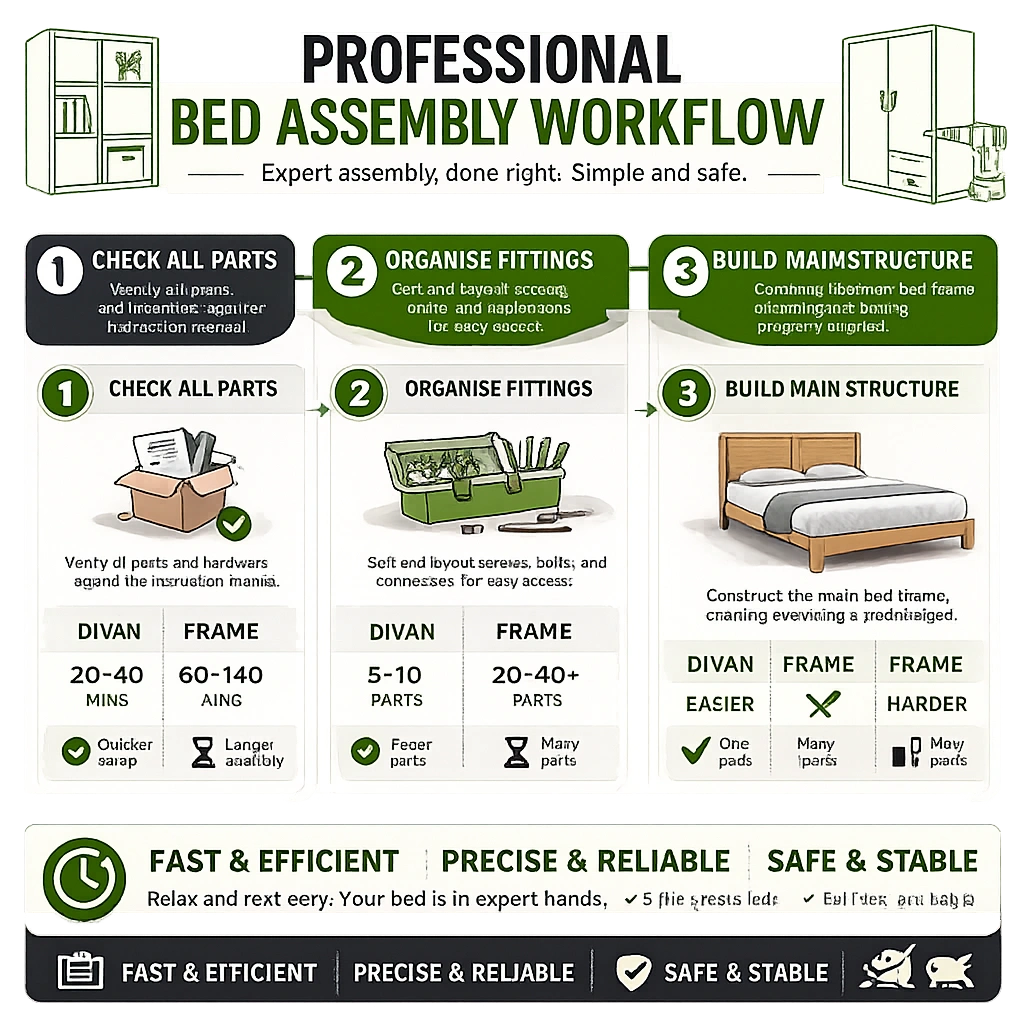
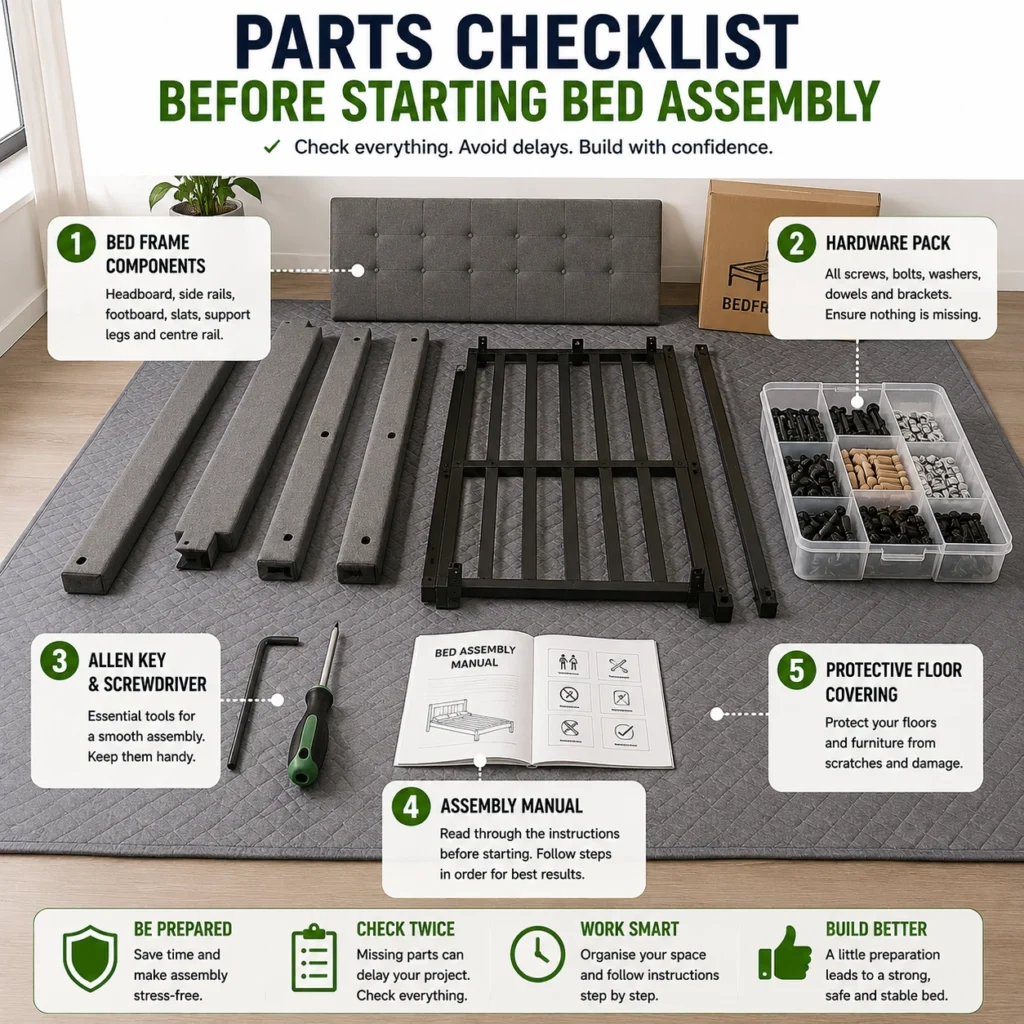
People often unpack every box at once without checking the instruction manual first. This makes finding the correct fittings much harder later.
Another common issue is tightening every bolt immediately. Professionals normally leave bolts slightly loose until the frame is fully aligned before completing the final tightening.
Incorrectly positioning centre support rails is another frequent mistake, especially with wooden frame beds.
Even during bed assembly London projects, experienced installers often find that previous DIY attempts have caused missing fittings, damaged fixings, or incorrectly installed support beams.
Ready to get started? Contact The Italian Tasker today for all your handyman and furniture assembly needs in London. We’re here to make your life easier and your home more functional and beautiful.
Storage Options Can Change Assembly Time
Storage is one of the biggest reasons people choose a divan bed. Built-in drawers or an ottoman lift make better use of bedroom space without needing extra furniture.
However, storage features can also affect installation time.
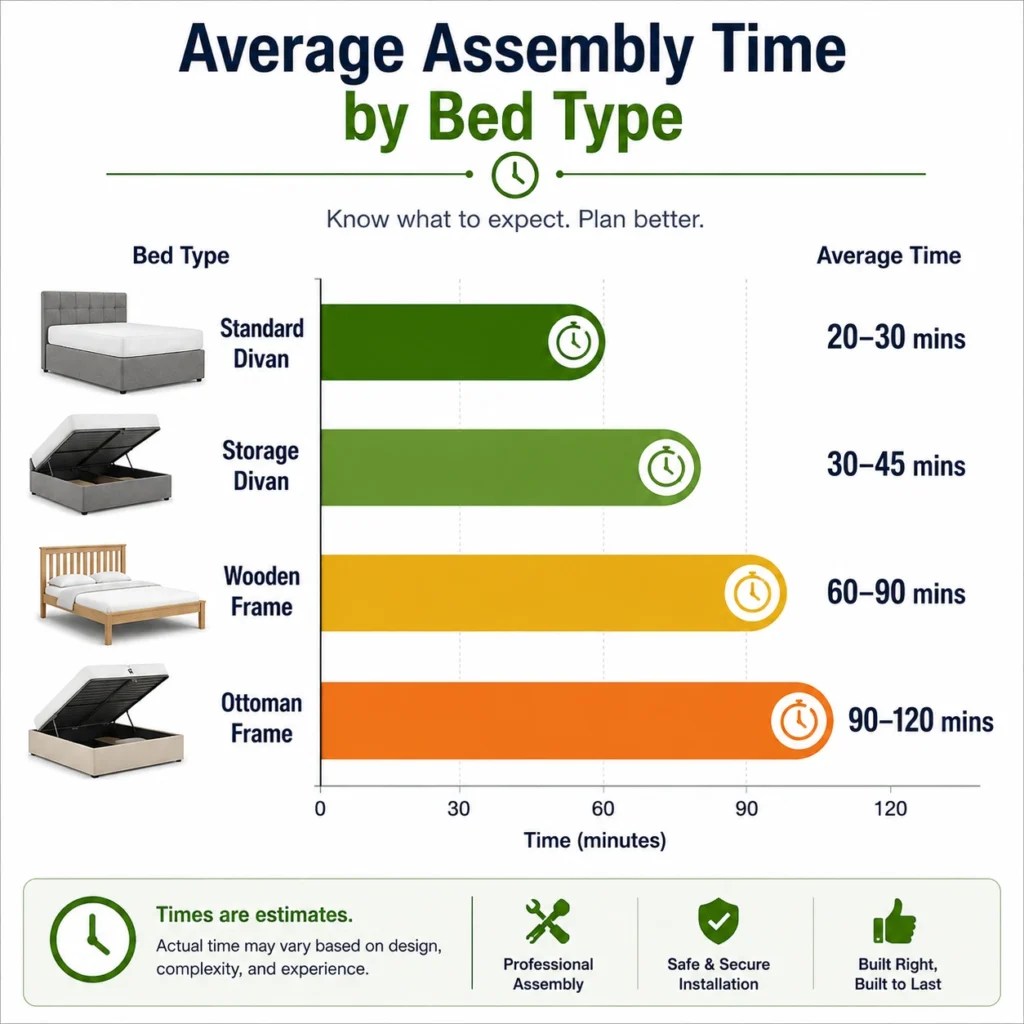
A standard divan bed with no storage is usually the quickest option to assemble. Models with drawers need the drawer runners to be checked and aligned, while ottoman divans require gas-lift mechanisms to be secured correctly. Even so, these beds generally have fewer individual parts than an equivalent storage frame bed.
Frame beds with built-in storage often require additional panels, drawer boxes, runners, centre supports, and lift hardware. Each extra feature adds more assembly steps and increases the likelihood of small alignment errors.
Long-Term Maintenance: Which Bed Is Easier?
Assembly is only part of the story. A bed that is simple to maintain can save both time and money over the years.
Divan beds contain fewer exposed joints, meaning there are fewer bolts that may loosen after repeated use. Maintenance is generally limited to checking the feet, headboard fixings, and storage mechanisms if fitted.
Frame beds benefit from occasional inspections because wooden slats, centre rails, and bolts can loosen naturally over time, especially after being moved. Tightening fixings every few months helps reduce squeaks and keeps the frame stable.
When moving house, divan beds also have an advantage because the base sections can often be separated without dismantling the entire structure.
Should You Assemble the Bed Yourself?
Many modern beds are designed for DIY assembly, but that does not mean every project is straightforward.
Manufacturers such as IKEA provide illustrated manuals and assembly guidance, encouraging customers to build furniture themselves. They also offer professional assembly services for customers who prefer expert installation.
DIY assembly may be suitable if:
- The bed has a simple design.
- Two people are available for lifting.
- All components and tools are present.
- There is enough clear floor space.
Professional installation is often the better choice when assembling large king-size or super king beds, heavy upholstered frames, or ottoman lift systems where precise alignment is essential for safe operation.
Choosing the Right Bed for Your Lifestyle
The quickest bed to build is not always the best choice for every household.
If you move frequently, live in a flat with narrow staircases, or simply want the fastest installation possible, a divan bed is often the more practical option. Its modular design makes transport easier and reduces the time needed for both assembly and dismantling.
Frame beds remain an excellent choice for buyers who prioritise a particular style or need a design with higher clearance underneath. They simply require more patience during installation and future moves.
When Professional Bed Assembly Makes Sense
Although many people successfully build their own beds, larger flat-pack furniture can quickly become more complicated than expected.
Professional bed assembly London services are particularly useful when:
- The bed contains hydraulic ottoman mechanisms.
- Multiple furniture items need assembling on the same day.
- Time is limited before moving in.
- Heavy upholstered components require safe lifting.
- Incorrect assembly could affect stability or manufacturer warranties.
Experienced installers also know how to identify missing hardware, damaged fittings, or manufacturing issues before assembly begins, reducing the chance of future problems.
If your priority is speed, easier transport, and simpler installation, divan bed assembly is usually the clear winner. If you value a wider range of styles and don’t mind spending extra time building and dismantling your furniture, a frame bed could be the better fit.
Have you recently assembled a divan or frame bed? How long did it take, and would you make the same choice again? Share your experience in the comments—it could help someone else decide.
Frequently Asked Questions
1. How long does divan bed assembly usually take?
A standard divan bed assembly typically takes between 20 and 45 minutes, depending on the size of the bed and whether it includes storage drawers or an ottoman lift. Since most divan bases arrive partially assembled, there are fewer components to connect than with traditional frame beds.
2. Is a divan bed easier to assemble than a frame bed?
Yes. In most cases, a divan bed is easier to assemble because it has fewer individual parts. You usually only need to join the base sections, attach the feet, and fix the headboard if required. Frame beds involve assembling side rails, slats, centre supports, and multiple fixings, which generally takes longer.
3. How much does professional bed assembly in London cost?
The cost of bed assembly London services varies depending on the bed type, size, and complexity. Standard divan beds are generally quicker and more affordable to assemble than large wooden or ottoman frame beds. Contacting a professional assembler for a personalised quote is the best way to get accurate pricing.
4. Can I assemble a divan bed by myself?
Many divan beds can be assembled by one person, especially single and double models. However, king-size and super king divan beds are heavier, so having a second person available makes the assembly process safer and easier.
5. Which bed is easier to move—a divan or a frame bed?
Divan beds are generally easier to move because the base separates into two manageable sections. Frame beds usually require complete dismantling before transport, which takes more time and increases the chance of losing fittings.
6. What tools are needed for divan bed assembly?
Most divan bed assembly jobs require very few tools. Depending on the manufacturer, you may only need an Allen key, screwdriver, or small spanner to attach the feet and headboard. Many beds even include the necessary tools in the packaging.
7. How long does it take to assemble a frame bed?
Frame bed assembly usually takes 45 to 120 minutes, depending on the size, design, and whether it includes storage features. Beds with wooden slats, centre support rails, or hydraulic ottoman systems generally require more assembly time.
8. Should I hire a professional bed assembly service?
Hiring a professional is recommended if your bed is large, heavy, has complex storage mechanisms, or if you want to avoid assembly mistakes. Professional installers have the experience and tools to complete the job safely and efficiently.
9. Can a divan bed be dismantled and reassembled after moving?
Yes. Divan beds are designed to be dismantled and reassembled easily. Most models simply separate into two base sections, making them ideal for people who move house regularly.
10. Why should I choose professional bed assembly in London?
Professional bed assembly London services help ensure your bed is assembled correctly, safely, and according to the manufacturer’s instructions. This reduces the risk of instability, damaged components, and unnecessary delays while saving you valuable time.